
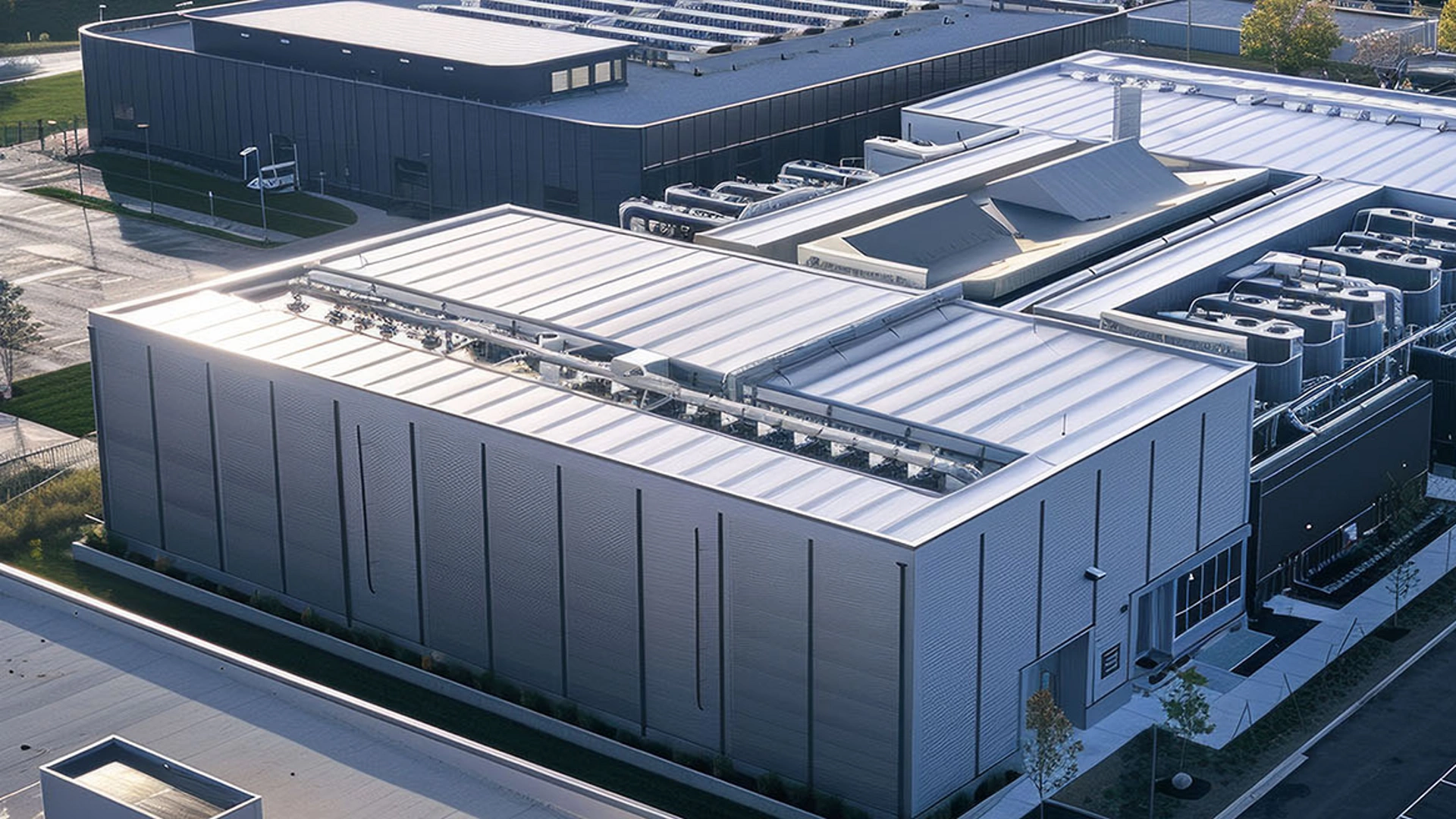
AI training workloads are redefining what it means to operate a hyperscale data center. Unlike traditional facilities, these environments introduce rapid, synchronized power fluctuations that can swing hundreds of megawatts in seconds.
This challenge is not simply about supplying more power, but also coordinating an increasingly dynamic and interconnected energy system in real time. Stabilizing AI infrastructure requires an orchestrated approach that aligns generation, storage, and load behavior into a single, responsive system.
Without that coordination, highly dynamic loads can strain onsite assets, trigger protection systems, and create instability risks both within the facility and across the grid.
A New Class of Power Variability
AI training infrastructure behaves fundamentally differently from traditional industrial loads. Instead of predictable ramp rates or steady-state consumption, thousands of GPUs and accelerators operate in synchronized bursts that drive rapid, large-scale swings in power demand. These dynamics introduce a range of system-level challenges, including:
- Frequency and voltage instability
- Protection system trips
- Mechanical stress on turbines and generators
- Increased risk of broader grid disruption
Taken together, these conditions exceed what most power systems were originally designed to handle. More importantly, they shift the problem from isolated equipment performance to coordinated system behavior.
From Interconnection Constraints to System-Level Design
The dynamic nature of AI loads is reshaping how hyperscale facilities interact with the grid. Utilities are increasingly cautious about direct interconnection, as large and rapid load swings can propagate instability beyond the site itself.
In response, operators are pursuing interim strategies such as islanded power systems built around onsite generation. While this approach can accelerate deployment, it introduces new tradeoffs, including higher operating costs, increased asset stress, and limited long-term efficiency.
These constraints highlight a broader shift: the challenge is no longer just where power comes from, but how it is managed as part of a coordinated, multi-asset system that must remain stable under extreme variability.
Emerson’s Approach: Coordinated Control as the Foundation for Stability
Stabilizing an AI data center requires coordinated control across all energy assets. Hyperscale sites increasingly operate as integrated energy systems, combining generation, storage, and grid interconnection. Managing this complexity requires:
- Millisecond-level response to load swings
- Coordinated dispatch of generation and storage
- Automated balancing to prevent instability events
- A unified operational view across all assets
Platforms such as the Ovation™ Automation Platform, supported by fully integrated SCADA systems , provide deterministic real-time control and system-wide visibility. This enables operators to manage diverse energy resources as a single, responsive system that turns volatility into something that can be actively controlled rather than passively absorbed.
Battery Storage as an Enabling Layer
Battery energy storage systems (BESS) play a critical role in stabilizing AI data center loads, but their impact depends on how they are integrated into the broader control architecture.
Within a coordinated system, BESS acts as a fast-response buffer that can:
- Absorb rapid increases in demand when compute loads spike
- Supply instantaneous power without stressing generation assets
- Capture excess energy when loads drop
- Smooth the net load profile seen by the grid or onsite generation
By moderating these fluctuations, BESS helps transform highly variable workloads into a more stable and predictable load shape. However, this capability is only fully realized when storage is orchestrated alongside generation and load dynamics within a unified control framework.
Extending Stability with Predictive Optimization
Maintaining real-time stability is only part of the challenge. Hyperscale operators must also continuously optimize performance, cost, and reliability as conditions evolve. In a fully orchestrated environment, these requirements are addressed through a complementary optimization layer that extends beyond real-time control. This includes capabilities such as:
- Forecasting AI-driven load behavior
- Anticipating renewable generation variability
- Planning asset availability and maintenance
- Optimizing fuel procurement and dispatch strategies
Platforms like the AspenTech Digital Grid Management (DGM) support these functions through:
- Day-ahead and intraday scheduling
- Forecast-driven operational planning
- Economic dispatch optimization
- Integration with real-time control environments
Together, these layers create a coordinated architecture in which:
- Real-time control systems maintain instantaneous stability, while
- Optimization platforms guide how the system should operate over time
This layered approach enables operators to respond to extreme volatility while improving efficiency, reducing costs, and preparing for grid integration.
Stability as the Foundation for Scalable AI Infrastructure
AI data centers are often viewed today as a potential risk to grid stability. However, with the right combination of capabilities, they can evolve into active participants in the energy system.
The ability to orchestrate energy systems across real-time control and predictive optimization layers will determine how effectively hyperscale facilities can scale, integrate with the grid, and operate efficiently over time. Ultimately, success will depend on how intelligently these systems are coordinated as part of a fully orchestrated energy architecture.
In this context, stability is not simply a technical requirement - it is the foundation that enables flexibility, resilience, and long-term sustainability. As AI infrastructure continues to scale, the ability to maintain stable, coordinated operations will define how effectively these systems support both operational performance and broader grid reliability.
Frequently Asked Questions About AI Data Center Power Stability
AI data centers, particularly the training type versus inference, create highly dynamic load profiles, with power demand rising and falling rapidly as compute systems operate in synchronized bursts.
Battery storage acts as a buffer that absorbs excess power with sudden load drops, and supplies extremely fast-response power when demand spikes, helping smooth fluctuations and stabilize the overall system.
Real-time control systems coordinate generation, storage, and load behavior in milliseconds to maintain stability and prevent disruptions.
Optimization is typically managed through forecasting and scheduling platforms—such as AspenTech Digital Grid Management—that help operators plan system operation, improve availability, and reduce costs.
Real-time control ensures stability during rapid load changes, while optimization tools help determine how the system should operate over longer time horizons to improve performance and efficiency.
Learn More
- Explore how the Ovation Automation Platform enables real-time control across hyperscale energy systems
- Learn how AspenTech Digital Grid Management (DGM) supports forecasting, scheduling, and operational optimization
- Discover how Emerson supports data center energy management for microgrid control and grid balancing
Source Acknowledgment
This Emerson perspective expands on industry challenges discussed in POWER Magazine, “The Power Problem Behind AI—and a Path to Fix It” (May 1, 2026), by Brett Benson and TJ Surbella. The original article outlines the challenges of AI-driven load volatility and the role of technologies such as battery storage and microgrid control. This page builds on those insights by highlighting how coordinated control and energy orchestration capabilities enable stable, scalable, and grid-compatible hyperscale operations. Read the original article ↗