
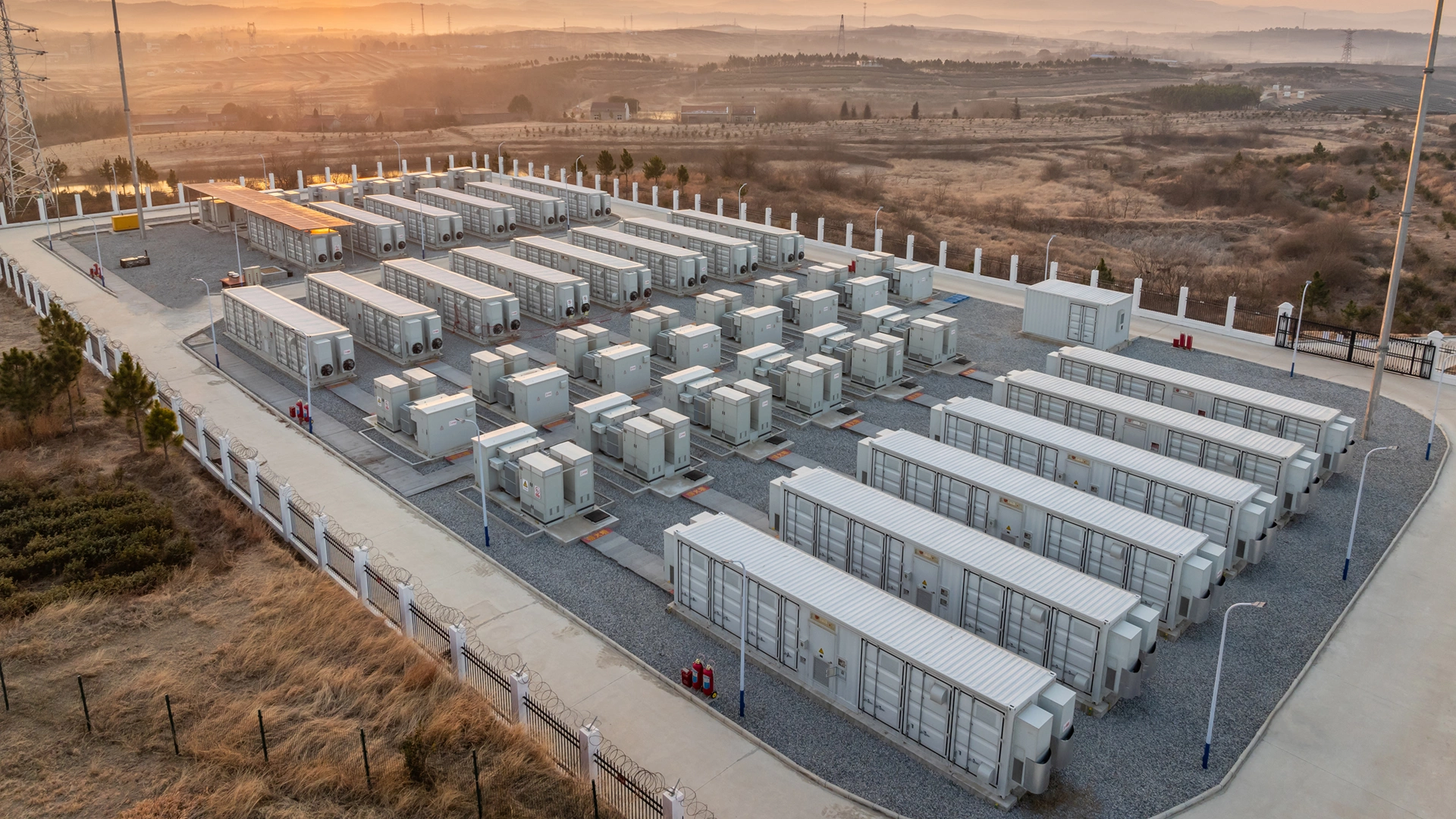
Emerson BESS control system applications coordinate battery energy storage plant response by managing active and reactive power, distributing charge and discharge setpoints, and responding to changing grid and operating conditions. Scalable Ovation™ control solutions support applications ranging from smaller BESS installations to large, redundant plant architectures while integrating with battery management systems, power conversion systems, SCADA software and energy management systems.

What Is a BESS Control System?
A BESS control system applies plant-level control logic to coordinate how a battery energy storage facility responds to operator commands, energy management objectives, grid signals and changing operating conditions. It uses information from battery management systems (BMS), power conversion systems (PCS), meters and other connected equipment to manage active and reactive power, distribute charge and discharge setpoints, and support plant and grid requirements.
Unlike the BMS, which manages individual batteries, modules and battery groupings, the BESS control system coordinates the response of the overall plant. Ovation control applications translate plant-level requirements into coordinated equipment action while accounting for equipment availability, state of charge (SOC) and operating limits.
- Coordinated Power Control
Manage active and reactive power, ramp rates and voltage or frequency response at the plant level.
- Scalable Setpoint Distribution
Allocate charge and discharge demand across multiple inverters using application-specific control algorithms.
- State-of-Charge Management
Account for battery availability, operating limits and state of charge when distributing plant demand.
- Flexible, Maintainable Control
Adapt control strategies to project requirements with configurable logic, accessible operating data and common engineering tools.
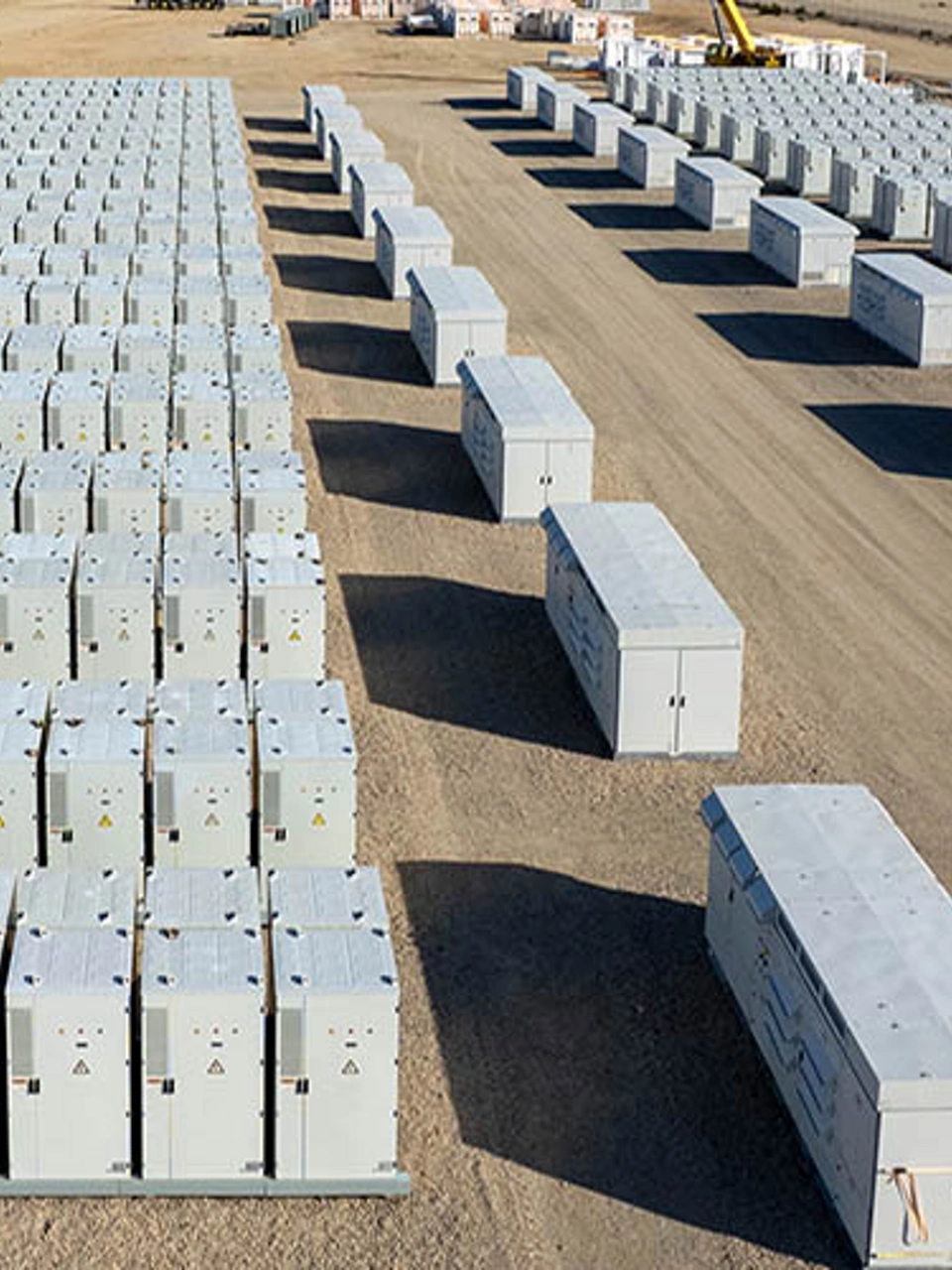
What Is a BESS Power Plant Controller (PPC)?
A BESS power plant controller (PPC) coordinates real-time plant response at the point of interconnection. It translates plant-level objectives and external commands into coordinated active and reactive power commands for the PCS, inverters and other connected equipment while using plant measurements and operating limits to manage the resulting response.
Within a BESS control architecture, the PPC provides the plant-level coordination needed to align individual equipment response with overall plant and grid requirements.
Active Power Control
Support plant-level active power setpoints, curtailment, ramp-rate management and other project-specific control strategies.
- Reactive Power and Voltage Control
Coordinate reactive power, power factor and voltage-support strategies according to plant and interconnection requirements.
- Point-of-Interconnection Coordination
Use grid measurements and equipment feedback to coordinate plant response at the point of connection.
- Real-Time Plant Response
Coordinate PCS and inverter response as operating objectives, grid conditions and plant availability change.
Scalable Ovation Controllers for BESS Applications
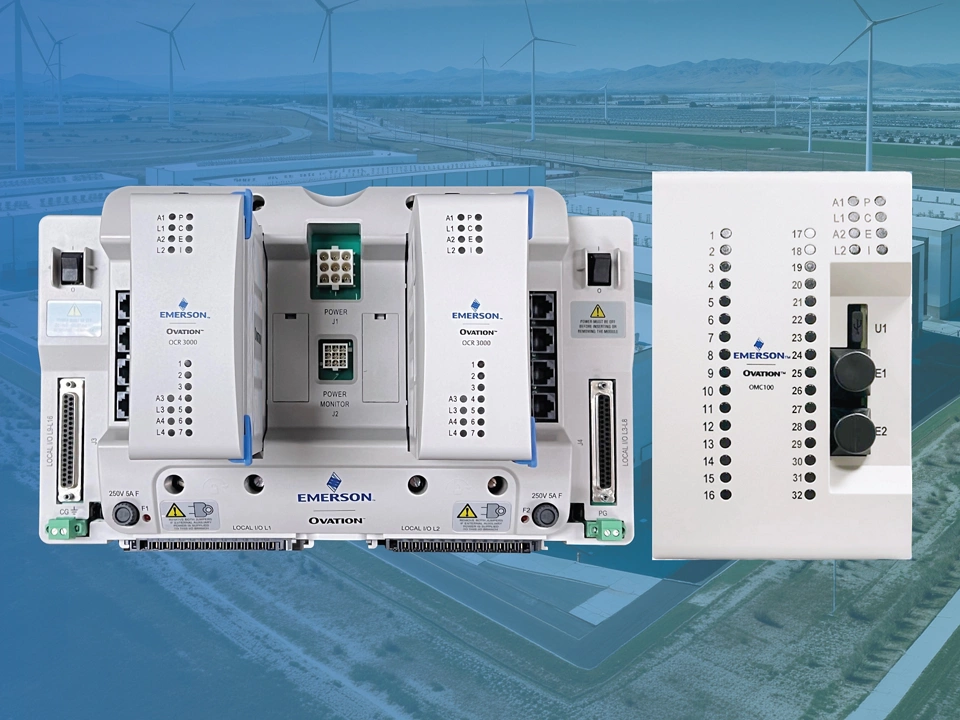
Emerson provides flexible controller options for implementing BESS control system and power plant controller (PPC) applications. Ovation controllers can support different plant sizes and architectures while providing a common foundation for real-time plant control.
Ovation OCR3000 Controller
The OCR3000 provides a high-performance controller platform for larger BESS applications requiring redundant plant control. It can execute power plant controller (PPC) and BESS control strategies as part of an integrated Ovation automation architecture.
Ovation OMC100 Controller
The OMC100 provides a scalable, compact controller option for smaller BESS applications that do not require redundant plant control. It can support PPC and plant-level control strategies while providing a flexible Ovation control platform for applications with less complex control-system requirements.
Connect BESS Control with SCADA and Energy Management
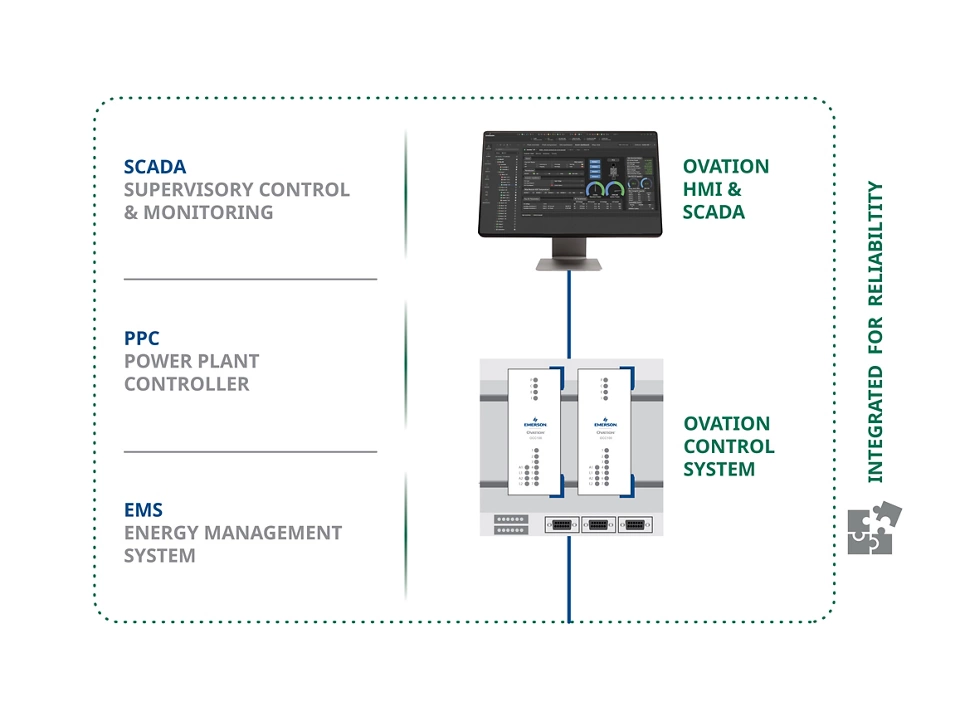
BESS control, SCADA and energy management perform distinct but connected functions. The BESS control system or PPC coordinates real-time plant response, SCADA provides operational visibility and communications, and the BESS energy management system (EMS) determines when and how stored energy should be used.
BESS SCADA System
Monitor connected BESS equipment, operating conditions, alarms and control information through a unified supervisory environment.
BESS Energy Management System (BESS EMS)
Coordinate scheduling, optimization and operating objectives to determine when and how stored energy should be used.
Coordinate BESS Equipment for Plant-Level Control
Ovation control applications coordinate information and control across BESS equipment and connected plant systems to execute plant-level operating requirements. Measurements, equipment availability and operating limits provide the inputs needed to distribute commands and coordinate plant response.
Battery Management Systems
Use BMS-provided battery availability, SOC and operating-limit information as inputs to plant-level control.
Power Conversion Systems and Inverters
Distribute active and reactive power or charge and discharge commands to connected PCS and inverter equipment.
SCADA Systems
Exchange operating information, controller status, setpoints and plant response information with the supervisory operating environment.
Utility and Grid Interfaces
Receive applicable external commands and exchange plant information through supported interfaces.
Fire Alarm Control Panel (FACP)
Use fire alarm status and related system information as inputs to support coordinated plant-level operation and response.
Meters and Grid Measurements
Use electrical measurements and equipment feedback to coordinate plant response and closed-loop control.
Energy Management Systems
Receive operating objectives and BESS availability information used in coordinating real-time plant response.

Support Grid and Plant Requirements
Ovation control applications coordinate BESS response at the plant's point of connection. Configurable control strategies can manage active and reactive power, dispatch setpoints, ramp rates, voltage and frequency response, and other project-specific requirements. Grid measurements, equipment feedback and operating limits provide the information needed to adjust plant response, while controller architecture can be selected to match application requirements.
- Active Power Control
Support curtailment, ramp-rate management, closed-loop setpoint dispatch, reserve operation and frequency response.
- Reactive Power and Voltage Control
Coordinate reactive power, power factor and voltage-support strategies according to plant and interconnection requirements.
- Point-of-Connection Coordination
Use grid measurements to coordinate plant-level response at the point of connection.
- Grid and Substation Interfaces
Exchange dispatch commands and plant information with substation equipment, utilities and transmission or grid operators through supported interfaces.
- Scalable Plant Control
Apply controller and control-system architectures appropriate for smaller BESS installations or larger applications requiring redundant control.
Frequently Asked Questions About BESS Control Systems and PPCs
A BESS control system applies plant-level control logic to coordinate how a battery energy storage facility responds to operating objectives, commands and changing plant or grid conditions. It coordinates connected equipment to manage active and reactive power, charge and discharge demands and other plant-level requirements.
A BESS power plant controller coordinates real-time plant response at the point of interconnection. It uses operating objectives, grid measurements, plant conditions and equipment information to coordinate active and reactive power response across connected PCS, inverters and other equipment.
A BESS control system describes the broader plant-level control capabilities used to coordinate battery energy storage operation. The PPC performs the real-time coordination required to translate plant objectives and external requirements into coordinated equipment response at the grid connection.
A battery management system monitors and manages battery-level conditions and operating limits. A BESS PPC uses information from the BMS and other plant systems to coordinate the response of the overall plant.
The energy management system determines when and how stored energy should be used based on operating objectives, while the PPC coordinates the real-time plant response needed to carry out those objectives.
The PPC executes coordinated plant-level control, while SCADA provides operators with visibility into controller status, plant setpoints, equipment response, alarms and other operating information.
Emerson can use the OCR3000 controller for larger applications requiring redundant plant control and the OMC100 controller for smaller BESS control applications. Controller selection depends on the requirements and architecture of the project.
BESS control applications can coordinate active and reactive power, ramp rates, voltage and frequency response, and other project-specific control requirements using grid measurements, plant operating information and connected equipment.