
Increase Production, Quality and Reliability without Disruption
Life Sciences manufacturers are under more pressure than ever to deliver treatments quickly and cost-effectively around the globe. With the world’s new focus on rapid results, gone are the days when the product could sit in work-in-progress (WIP) for days, weeks, or even months, waiting on lab testing for quality validation.
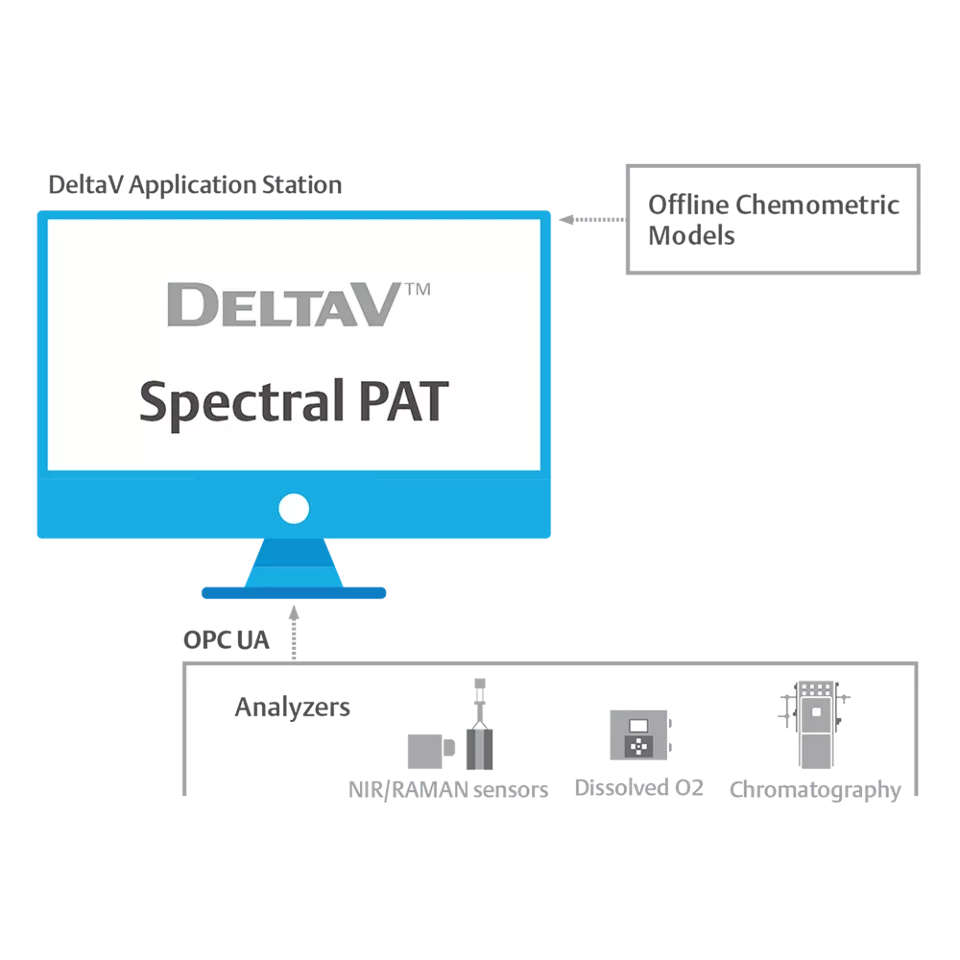
DeltaV Spectral PAT brings stability and performance by bringing spectral waveform data directly into the control system. By implementing in-line, real-time, continuous, closed-loop process verification and control with an automated real-time quality release, manufacturers build a foundation for better regulatory management more easily while optimizing facility performance and throughput.


Improve Product Quality and Process Performance with Real-Time Predictive Control
DeltaV Spectral PAT runs chemometric models directly in the control system, allowing real-time prediction of critical quality attributes. This means that you can now monitor and perform closed-loop control with these hard-to-measure critical values. DeltaV systems have built-in solutions to show and document safe, accurate, repeatable processes. Demonstrating these technologies can give regulatory groups the confidence they need to support this new approach to improve manufacturing performance.
DeltaV Spectral PAT is easier to implement and maintain by leveraging a standard DeltaV configuration, database, and support infrastructure used by your other control applications. Working in a single, integrated DeltaV platform environment enhances the system’s security and simplifies your process validation.
Traditional implementation of PAT using spectroscopy can be challenging to implement and maintain, mainly when critical quality measurements are used in closed-loop control strategies. Using spectral analyzers from on-line product samples, DeltaV Spectral PAT’s modern machine learning algorithms and embedded chemometric models can accurately predict product quality for use as on-line quality soft sensors.
Frequently Asked Questions
DeltaV Spectral PAT enables real-time quality monitoring in pharmaceutical manufacturing by using in-line spectroscopy and embedded chemometric models to predict critical quality attributes. This approach eliminates delayed lab testing and supports continuous process verification within a distributed control system (DCS).
DeltaV Spectral PAT reduces time to market by enabling real-time release and eliminating delays associated with laboratory testing. This accelerates production cycles and allows life sciences manufacturers to bring products to market faster.
DeltaV Spectral PAT differs from traditional PAT systems by embedding analytics directly into the control system instead of using complex, multi-layer architectures. This simplifies integration, improves reliability, and enables real-time closed-loop control in industrial processes.
DeltaV Spectral PAT improves product quality by continuously analyzing spectral data and applying machine learning models to monitor critical quality attributes. This helps reduce batch variability and ensures more consistent product outcomes in pharmaceutical manufacturing.
DeltaV Spectral PAT supports regulatory compliance by providing consistent, traceable data and automated documentation within the DeltaV platform. This helps organizations meet validation and regulatory requirements more efficiently in regulated industries.
DeltaV Spectral PAT reduces implementation and maintenance costs by leveraging existing DeltaV infrastructure and eliminating the need for separate PAT systems. This simplifies engineering, reduces validation effort, and lowers total cost of ownership.