
Products
Products

Liquid Level Switches

Solids Level Switches
Resources
Frequently Asked Questions
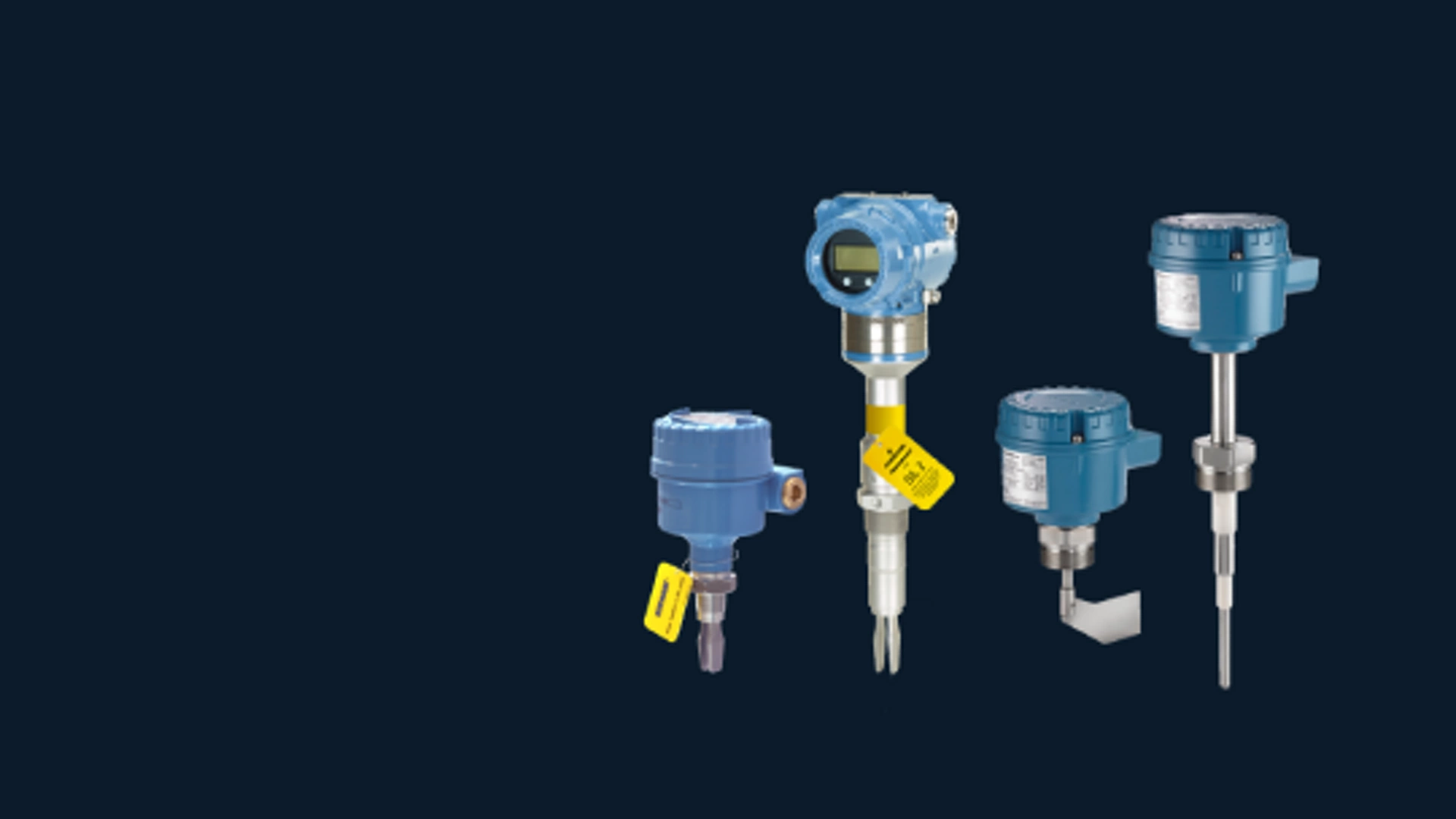
- Point level measurement works like a switch, it detects if material is present at a specific level and sends an on/off signal. It’s used for high/low alarms or pump control. Common technologies include vibratingforks, paddles, vibrating rods, and capacitance switches.
- Continuous level measurement provides real-time reading across the full range of the tank or silo. It’s used for inventory, process control, and monitoring. Technologies include guided wave radar, non-contactingradar, and differential pressure.
A vibrating fork level switch offers several advantages compared to other point level detection technologies like float switches or optical sensors:
- Reliable in difficult media
Works well with a wide range of liquids and solids, including foams, viscous fluids, and materials with low dielectric constants. - No calibration required
Unlike capacitance or ultrasonic sensors, vibrating forks typically don’t require calibration, simplifying installation and maintenance. - Fail-safe operation
Many models offer fail-safe high or low settings, ensuring safe operation in critical applications like overfill or dry-run prevention. - Compact and easy to install
Simple mechanical design with minimal moving parts reduces wear and increases reliability. - Immune to changes in process conditions
Performance is unaffected by changes in pressure, temperature, density, or dielectric properties, unlike some other technologies.
These technologies are ideal for overfill protection, dry-run prevention, or pump control:
1. Vibrating Fork Switches
- Reliable in liquids and solids
- Insensitive to change in process conditions and media density
- Great for safety-critical applications
2. Capacitance Probe
- Good for conductive and non-conductive media
- Unaffected by build up
3. Paddle Switch
- Bulk solids like powders, granules, pellets
- Low or high level detection in silos or bins
4. Vibrating Rod
- Easy flowing granulars, powders and light bulk solids