

Refinery Increases Profitability by Using Opportunity Crudes While Minimizing Corrosion Problems
RESULTS
- Increased refining profit spread by using low-cost opportunity crudes
- Verified equipment conditions to avoid shutdowns
- Quantified the corrosion aggressiveness of various crudes
Customer
European refiner operated by integrated major oil and gas producer.
Application
Refinery piping and equipment that were prone to increased wear-and-tear or worse – catastrophic failure.
Challenge
Low commodity prices have changed the financial considerations for all phases of the oil and gas industry, including downstream operations such as refineries. For some facilities, the only means to improve profitability is to buy opportunity crudes – feedstocks from secondary sources at lower than-market prices. These feedstocks are less expensive because they often carry corrosive and erosive contaminants capable of destroying production piping and equipment from the inside out.
For a refinery processing 300,000 to 500,000 barrels each day, saving even $1 or $2 per barrel of feedstock can improve the profit picture considerably, but this approach can add costs through increased wear-and-tear on piping and equipment. Worse – a catastrophic failure where a pipe breaks or vessel ruptures due to internal corrosion can result in enormous costs through fires, environmental damage, and personnel injury.
Determining the condition of various pieces of piping and equipment through manual inspection is not reliable, often forcing producers to risk equipment failure by running units too long, or requiring them to be too cautious and shut down or replace items that could still operate safely. Some facilities add corrosion inhibitors, but this is costly and the effectiveness is difficult to evaluate. Moreover, the chemical mix and dosage rate may need to be adjusted with each new batch from a different source as corrosiveness varies widely.
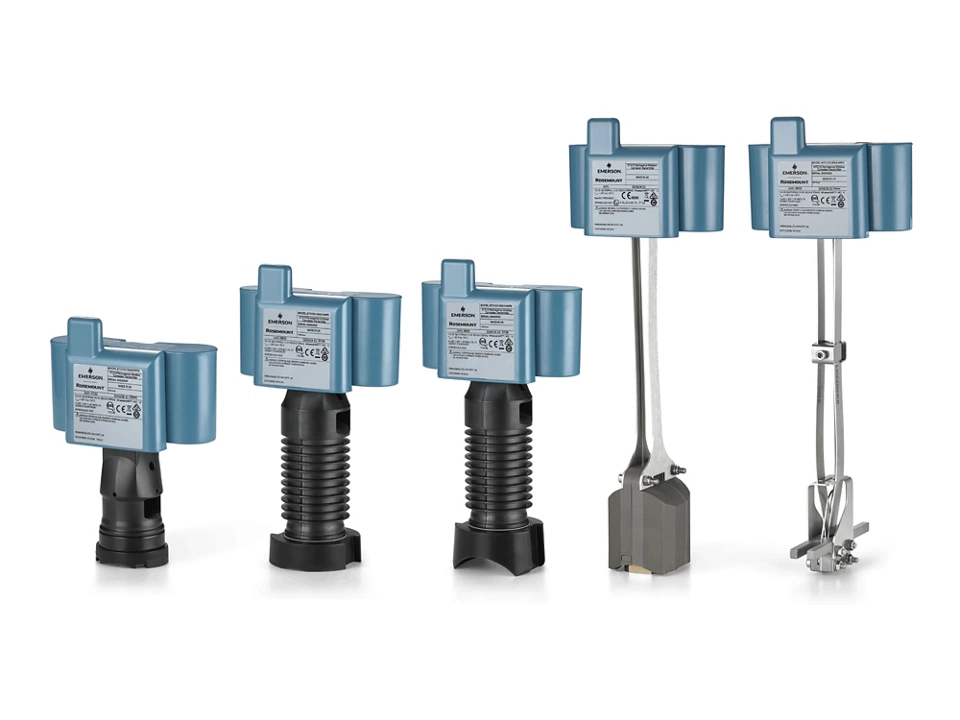
Emerson’s Rosemount Wireless Corrosion and Erosion Transmitter portfolio.
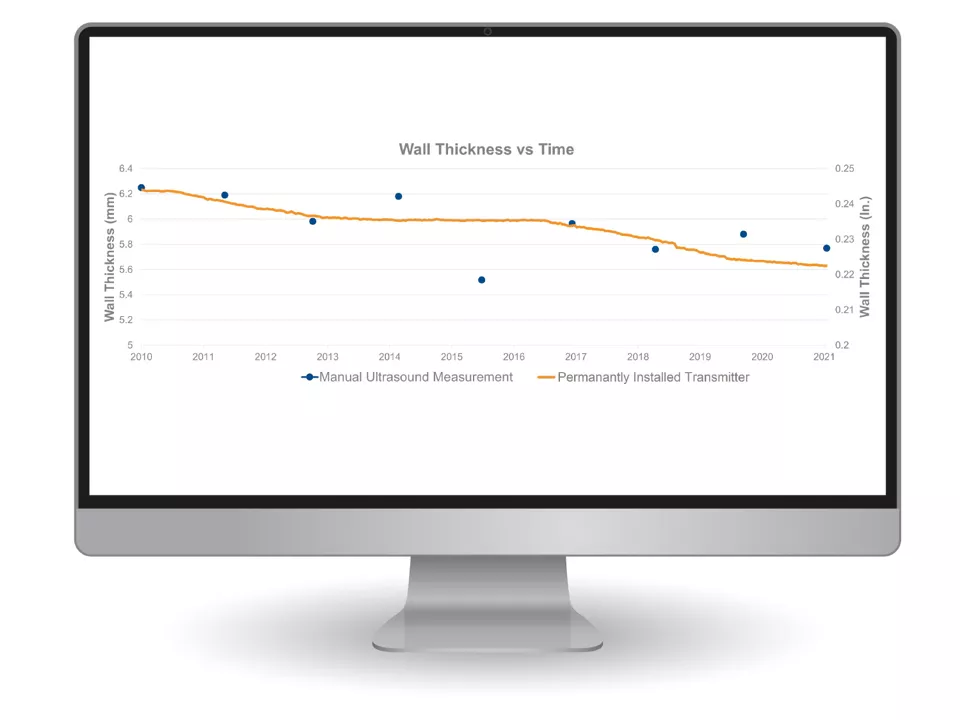
Each transmitter provides continuous measurements of equipment wall thickness.
Solution
Managers of this refinery made an intentional choice to process opportunity crudes routinely for the cost advantage. Aware of the associated problems, they decided to deploy appropriate components and systems to monitor pipe and vessel wall thickness to determine the degree of metal loss resulting from processing high total-acid number crudes.
Technicians installed about 400 Rosemount™ Wireless Corrosion and Erosion Transmitters on equipment in critical areas. These transmitters monitor wall thickness continuously and send data to analysis software via a WirelessHART® network. The ability to install these transmitters without the very high cost of adding cabling made the project far more affordable. Since each transmitter has an internal power module sufficient to operate for five years and more, the maintenance cost of the transmitters is effectively zero.
The analysis software provides a current thickness reading in the context of historical data and trends. Watching it over time shows trends with sufficient resolution and precision (repeatability of ±10 microns) to determine the rate of metal loss for a specific batch of crude running for as little as a week. Since the facility typically runs 40 to 50 batches from various sources over a year, the software can effectively catalog the characteristics of each, identifying those which tend to cause the heaviest damage. Where corrosion inhibitors can be used, the continuous data provides an indication – in a matter of days – if the inhibitor is working properly and if the dosage is correct. This information can also be cataloged for future reference.
With both current and historical data, operators can project the rate of metal loss and determine the expected remaining life of any part of the process piping or equipment with a high degree of confidence. This minimizes the potential for a disastrous failure, and also the cost of an unnecessary shutdown prompted by uncertainty.
Once sufficient data and trend information had been collected, facility engineers were able to analyze the effects of specific operating conditions in addition to the characteristics of the crude oil. In one particularly telling situation, overall corrosion increased noticeably system-wide, beyond that attributable to the crude batch. Analysis of operating conditions showed a strong correlation between the aggressive corrosion and a change in a critical process parameter. Since this was identifiable in a short time, the change was mitigated before the damage became worse.
For more information, visit
Emerson.com/Corrosion-Erosion