

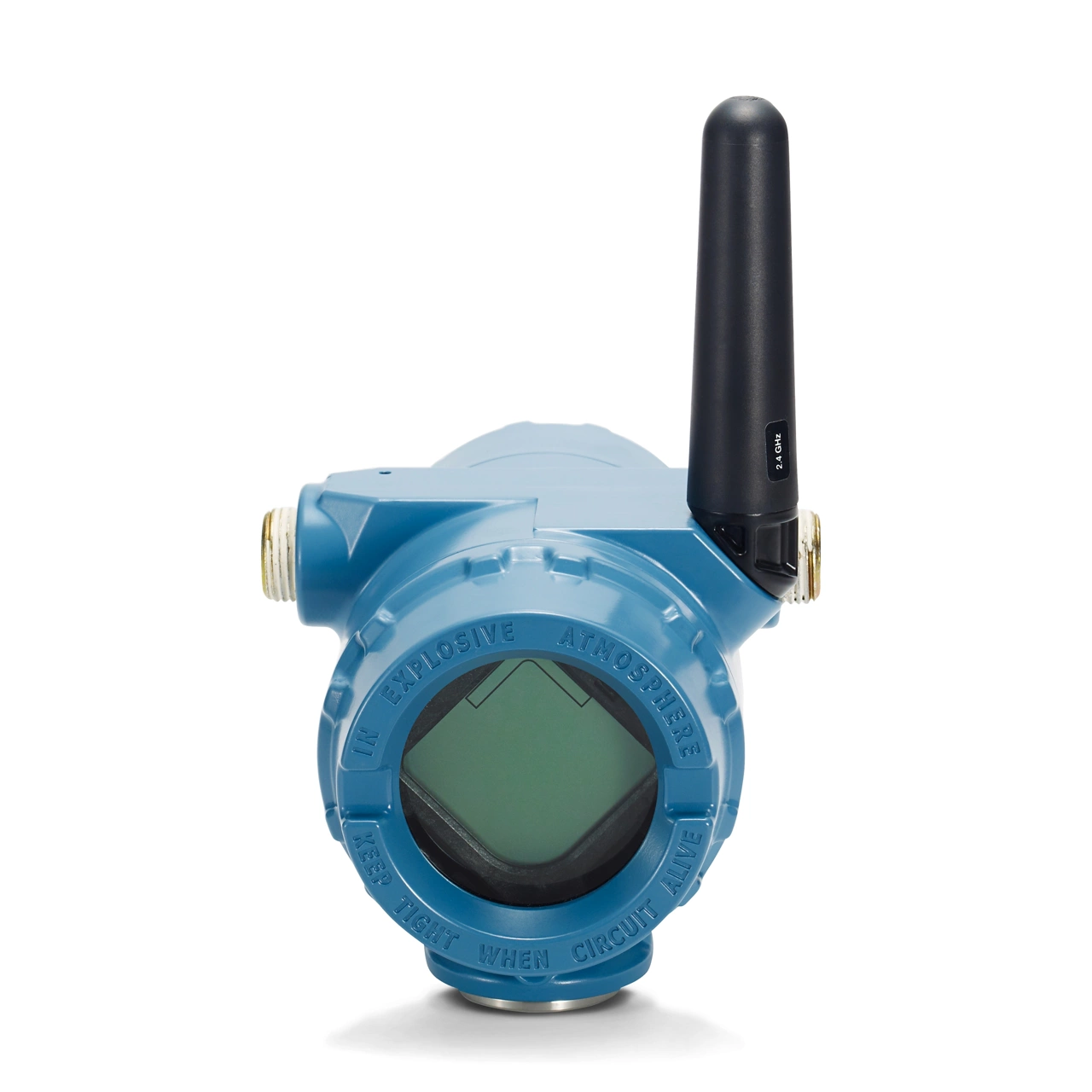
Rosemount™ 705 Wireless Totalizing Transmitter
Enhance turbine flow measurement with the Rosemount 705 Wireless Totalizing Transmitter.
Key Features
- Ready-to-install and easily connects to turbine meter or pulse output devices
- 0-10khz pulse input specification provides a variety of application connections
- Remote or direct mount allows for flexible installation and operation
- Remote antenna options offer additional flexibility and long range communications
- Possible applications include adding existing field installation to measure water flow on injection wells
- WirelessHART® technology is secure, cost-effective and delivers>99% data reliability
Frequently Asked Questions
705 Totalizing Transmitter Basics
The Rosemount 705 provides an installation-ready way to connect a turbine flow meter or other pulse output device to a WirelessHART® network. It converts a 0–10 kHz pulse signal into two continuously updated measurements — average flow rate and totalized volume — and transmits both wirelessly with greater than 99% data reliability, enabling monitoring of flow points that were previously stranded or too costly to wire.
The Rosemount 705 accepts a pulse input from a turbine meter or other pulse output device and uses a user-configured K-factor to convert pulse frequency and accumulation into average flow rate and totalized volume. The K factor is typically supplied by the manufacturer of the pulse generating devices. The 705 continuously calculates flow and volume between wireless updates.
The 705 works with mechanical turbine flow meters and other pulse output devices that meet the following input criteria:
- Signal type: Pulse (frequency) output. A sinosoidal output is preferred, very fast square outputs may not be readable.
- Frequency Range: 3 Hz to 10,000 Hz
- Sensitivity : minimum 10 mV, up to 42.2 V
- Calibration factor: A known K-factor must be input for the 705 to convert pulses into flow rates and totalized volume
The 705 reads an incoming signal and does not supply voltage to the pulse output device, so the meter must supply its own output.
Applications & Industries
Typical applications include stranded flow measurements, well pad water injection monitoring, utility monitoring, portable well testing packages used to characterize new or existing wells before they are put into full production, and wellhead flow monitoring in mining.
The 705 is most widely deployed in upstream oil and gas - wellhead characterization and well pad fluid monitoring - with additional use in mining, and industrial plant utitlity monitoring. It can be used anywhere a turbine meter or pulse output device exists but running new wiring back to the control system is impractical or costly.
Yes. The 705 is a core component of Emerson’s portable well testing solutions, where it captures turbine meter pulse output and converts it to flow data as part of a rugged, easily deployable package used to validate new-well production performance. It is commonly paired with wireless pressure, temperature, and gas/corrosion monitoring devices in the same test package for a complete picture of well conditions during characterization, which can run from a few days to several months.
Certifications, Power & Installation
Yes. The 705 is available with intrinsically safe certifications for use in classified hazardous locations. IECEx and ATEX intrinsic safety options are rated Zone 0, covering common upstream oil and gas applications. USA and Canada instrinsic safety approvals, certified by CSA, cover Class 1, Division 1, with non-incendive options available for Division 2.
Yes — the 705 uses a replaceable, intrinsically safe lithium-thionyl chloride SmartPower™ module. Emerson’s SmartPower design allows the module to be replaced in the field without removing the transmitter from service, supporting up to 10 years of battery life depending on update rate and network position.
The 705 has a user selectable update rate from 1 second to 60 minutes. Several antenna options are available, including standard external, extended-range external, and remote antenna configurations, so the transmitter can be matched to the communication requirements of the installation.
The 705 can be direct-mounted to a turbine meter using the threaded 1-in. NPT connection, or ordered with the remote mount option, which includes 10 ft. of cable for installations wehere direct mounting isn't practical. An optional universal L bracket permits 1.5 to 2-in. pipe mounting. Housing is available in low copper aluminum or stainless steel, and an optional LCD display is available showing totalized volume, average flow rate, and diagnostic information.
Configuration, Integration & Value
Three settings are critical to accurate operation: K-factor (the pulses-per-unit-of-measurement value specific to the connected turbine meter, often pre-configurable at the factory), Volume Units (the unit of measurement used for totalized volume), and Roll Over Point (the value at which the totalizer resets to zero). Flow units and filter period are also configured to control how flow rate is displayed and smoothed.
Yes. The 705 can be reset via the wireless network, through the wireless gateway, using a button located behind the electroncs/LCD display side housing cover, or by connecting to the local wired maintenance port. To avoid any loss of volume accumulation, the totalizer should only be reset when flow through the attached turbine meter has stopped.
The 705 communicates over WirelessHART® (IEC 62591) to an Emerson Wireless Gateway, which translates the data into standard protocols (HART-IP, Modbus, OPC) for your existing DCS, PLC, or SCADA system — the same self-organizing, self-healing mesh architecture used across Emerson’s wireless portfolio. As with all WirelessHART devices, the 705 should be joined to the network only after the gateway is installed and functioning, starting with devices closest to the gateway for the smoothest commissioning.