

Fujifilm Fast-Tracks America's Largest Cell Culture Contract Development and Manufacturing Organization
More than two billion people worldwide do not have access to medicine, and it’s only getting worse. The COVID-19 pandemic showed that ramping up the production of medicines at breakneck speed can be of vital importance.
FujiFilm's Pandemic-Ready Manufacturing Model
FujiFilm Diosynth Biotechnologies, a global contract development and manufacturing organization (CDMO) and provider of cell and gene therapy and viral vaccine products, has leveraged key learnings from the pandemic to be more flexible and agile. FujiFilm doesn’t make its own products; it quickly gets them to market for others. It offers solutions for cell line development, process development, late phase activities, clinical and commercial manufacturing of a wide variety of biopharmaceuticals. CDMOs can be a vital cog in a well-orchestrated effort to quickly manufacture vaccines, such as happened during the pandemic.
FujiFilm manages the largest cell culture CDMO in North America, located in Holly Springs, N.C. The 1 million-square-foot facility opened in 2025. The company has additional U.S. locations in Cambridge, Mass., College Station, Texas, and Thousand Oaks, Calif., in addition to Hillerød, Denmark, and Teesside, U.K.
Jacob Grønnegaard, Director of Automation for FujiFilm Diosynth Biotechnologies, says the company had speed and flexibility in mind when it built its North Carolina facility.
"We change products, so we need to have flexibility in our facilities," Grønnegaard said.
Why Speed and Flexibility Matter
FujiFilm has been through this process before. The Holly Springs site is a nearly identical clone to its Hillerød facility. “We take a different approach. We want to reduce the time to completion,” Grønnegaard said.
That’s why FujiFilm used a cloning-across-sites system that is built on utilizing Drug Substance Manufacturing (DSM) modules. The modules are designed with identical automation concepts intended to allow for fast scalability for production and agility and redundancy for supply chain management.
Grønnegaard said the company increases cloning percentage as a project progresses. “As we move from DSM expansion to completion, we increase the percentage with the ultimate goal of delivering the completed project in less than 24 months lead time, 50% of the working hours and 85% of the installed costs of the previous facility.”
Understanding DSM Modules
What is a DSM module? The modules are the core of the facility, and it’s where the production takes place. Each module consists of two upstream trains, four production bioreactors, a harvest suite and a purification suite.
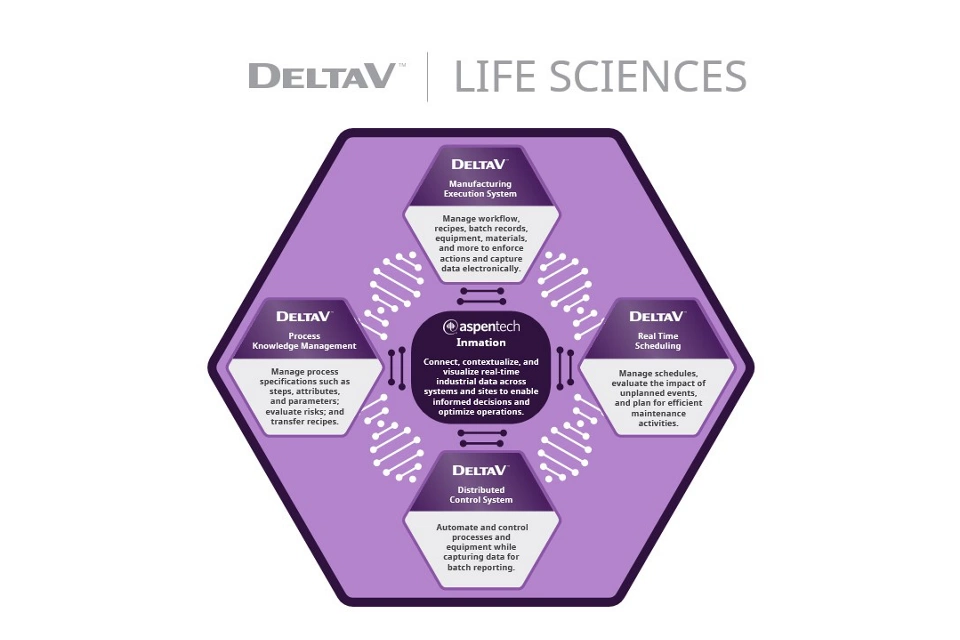
Such a highly sensitive environment needs a high-level system architecture. Each DSM module has its own Emerson DeltaV automation system and two DSM modules will share an Emerson Syncade manufacturing execution system (MES).
The DSM modules in Holly Springs are the same as the Denmark facility. Both facilities have the same layout and process equipment. They have the same process and instrumentation diagrams (P&IDs) and 3D engineering models. Most notable is that they have the same DeltaV and Syncade application code. The only localization, according to Grønnegaard, are for required building code differences between the U.S. and Denmark, such as electrical standards. Both facilities will be governed by the same standard operating procedures.
Automation Drives Production Scalability
Grønnegaard outlined FujiFilm’s DeltaV application code development process utilizing its unique cloning procedure during the session. Before the process even begins, the application code is developed for the initial DSM and goes through full qualification testing. From there, FujiFilm exports the DeltaV code and design documents. It uses a qualified tool to convert tag numbers complete with code and graphics from the initial DSM to the new DSM. It uses a qualified tool to update design documents with the new DSM tag numbers.
FujiFilm then implements any changes that exist between the new DSM and initial DSM. From there, it qualifies each change individually. Finally, the DeltaV code is qualified as ready for use during equipment commissioning.
The result is creating one of the top medicine production facilities in the country. Hopefully, it won’t have to ramp up production for a virus vaccine to combat a worldwide pandemic, but if the time ever comes again, it will be scalable and ready.
Why It Matters: Replication and Operational Efficiency at Scale
FujiFilm's cloning-across-sites strategy reduces time-to-production, minimizes rework and lowers capital costs. By replicating automation systems, process designs and Emerson DeltaV control configurations across sites, FujiFilm achieves operational consistency and faster market readiness.