

Reducing Unplanned Downtime and Improving Operational Performance in Oil and Gas
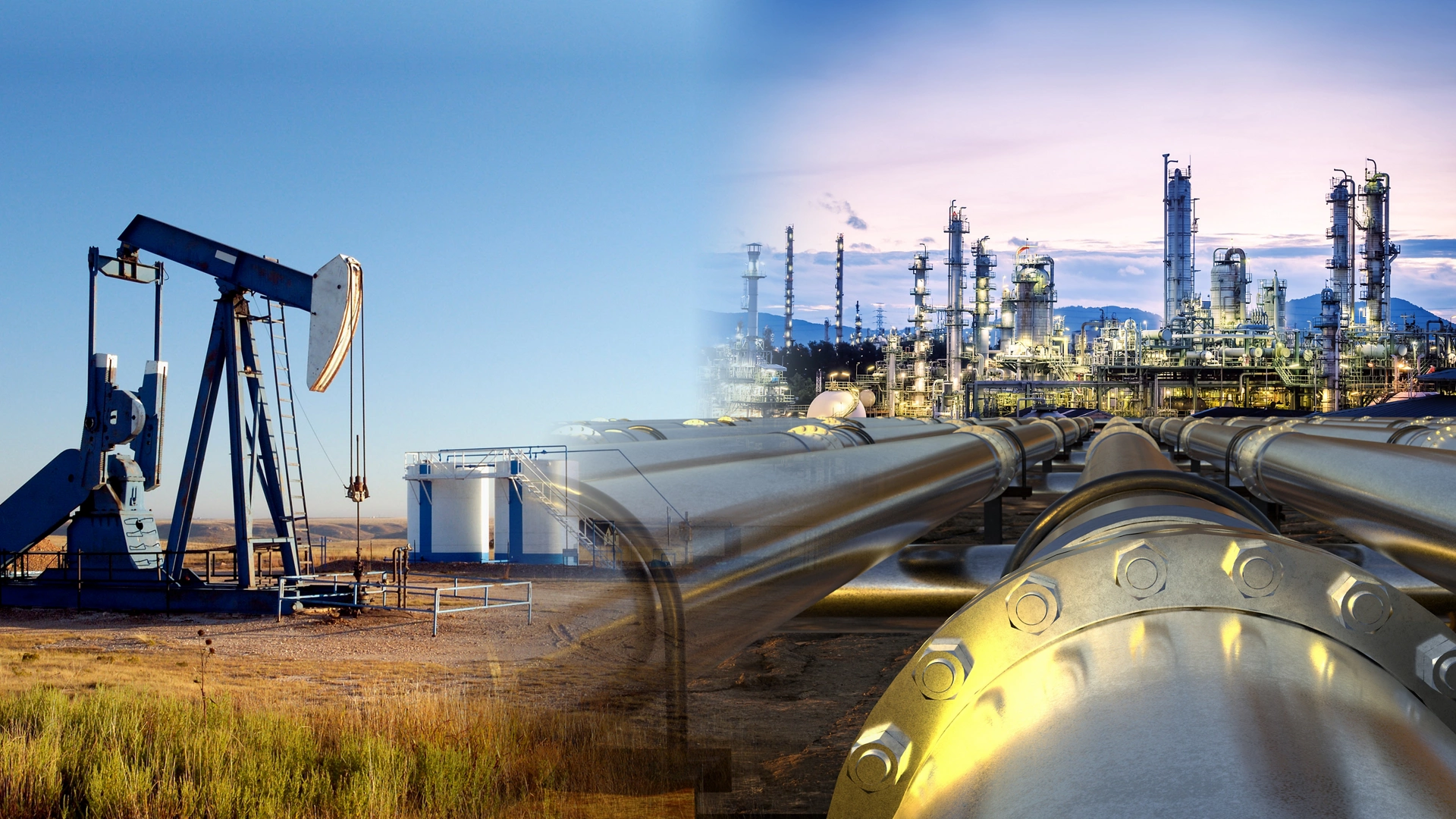
From custody transfer measurement in pipelines to advanced process control in refineries, oil and gas operators rely on Emerson to address the most critical challenges in production efficiency, safety, and emissions management. Emerson's portfolio of automation systems, flow measurement devices, safety instrumented systems, and control valves gives operations teams the tools to reduce unscheduled downtime, meet production targets, and maintain compliance across every segment of the value chain.
Reduced Capital Cost
Reducing geological risk for exploration, drilling, and field development.
Average Maintenance Cost Reduction Per Year
Predict and prevent failures with AI-driven analytics and real-time monitoring to ensure reliable operations.
Average Improvement of Margins Per Barrel of Crude for Refining and Olefins
Implement next-generation technology for sustainability and agility
Reduction in Energy Consumption
Improve energy management with intelligent automation and control solutions that drive cost savings and sustainability.
Oil & Gas Industry Segments
Emerson delivers end-to-end solutions that connect upstream, midstream, and downstream operations through pervasive sensing, advanced process control, predictive analytics, and industrial software. These integrated technologies help energy companies reduce risk, improve throughput, safeguard assets, and protect margins—turning complexity into competitive advantage from the reservoir to the refinery.

Optimize Reservoir Performance and Production
Improve recovery, reduce risk, and lower lifting costs
Upstream profitability depends on maximizing reservoir performance while controlling operational risk. Emerson helps operators overcome production constraints—such as equipment failures, artificial lift inefficiencies, and measurement uncertainty—using advanced reservoir modeling, intelligent automation, and real-time production insight to drive safer, more predictable, and more profitable operations.
Media, Case Studies, & Success Stories
From enhancing operational efficiency to ensuring safety and compliance, our case studies and media highlight real-world applications of our technologies. Discover how industry leaders are leveraging our solutions to overcome challenges and achieve success in upstream, midstream, and downstream sectors.
Unlock the Power of Automation: Transforming Operations for Growth, Efficiency, and Resilience
In today's rapidly evolving world, automation is essential for businesses to reduce costs, enhance productivity, and stay competitive. Join our webinar in partnership with Hydrocarbon Processing to explore how modern automation technologies can drive operational excellence and long-term value.

The Business Groups Behind Every Oil & Gas Solution
Emerson's business groups each bring deep specialization in specific product lines — from automation systems and control valves to precision measurement instruments — that underpin every solution across the oil and gas value chain. Explore the links below to find the specific products, technical resources, and engineering expertise most relevant to your operations.
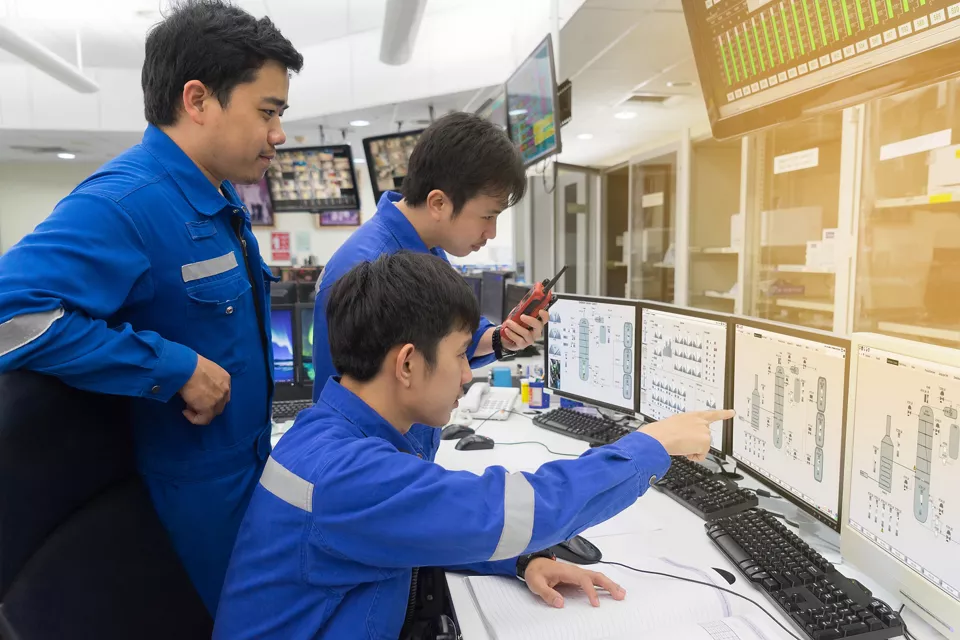
Automation Systems
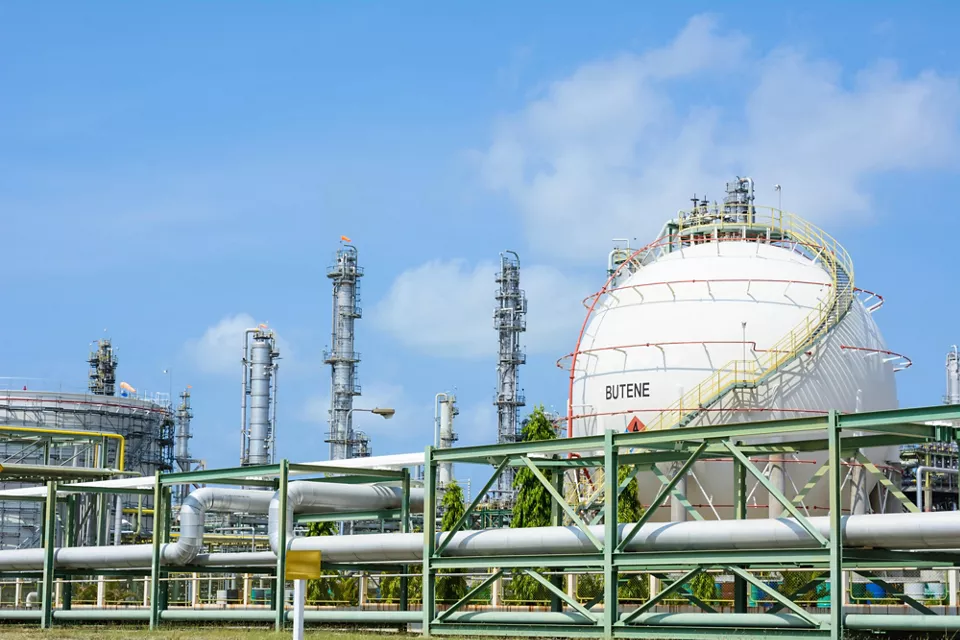
Discrete Automation

Final Control
Measurement Instrumentation
Frequently Asked Questions (FAQs)
From flow measurement and corrosion monitoring to safety systems and process automation, the following questions address the technologies and strategies that drive performance across upstream, midstream, and downstream operations.
Accurate flow measurement is foundational to every segment of oil and gas — from production allocation and wellhead monitoring to pipeline custody transfer and refinery feed optimization. Emerson's flow measurement portfolio covers the full range of technologies the industry requires: Coriolis meters for high-accuracy liquid and gas mass flow, ultrasonic and clamp-on meters for large-bore or non-intrusive applications, vortex and differential pressure-based meters for steam and utility services, and magnetic meters for produced water and aqueous streams. The right technology selection depends on fluid composition, phase behavior, required accuracy, and whether the installation permits pipe interruption. Emerson's Micro Motion Coriolis line and Flexim clamp-on ultrasonic meters represent two ends of the spectrum — one providing laboratory-grade accuracy for fiscal measurement, the other enabling installation without a shutdown window.
Differential pressure is one of the most widely used measurement principles in oil and gas, applied everywhere from wellhead choke monitoring to compressor performance tracking to separator level control. DP transmitters measure the pressure difference across a primary element — an orifice plate, Venturi tube, or annubar — to infer flow rate, or they measure static head across a vessel to infer liquid level. In upstream applications, DP is central to multiphase separator control and artificial lift optimization. In midstream compression stations, it tracks filter differential and compressor suction-discharge conditions. Downstream, it controls column differential pressure in distillation units, which directly affects separation efficiency and energy consumption. Rosemount DP transmitters with multivariable capability can simultaneously measure differential pressure, static pressure, and process temperature from a single connection point, which reduces both installation cost and potential leak points in hazardous service.
Unmanaged corrosion and erosion are among the leading contributors to unplanned shutdowns and safety incidents across oil and gas operations. Emerson's approach centers on continuous, non-intrusive monitoring rather than periodic inspection — providing real-time data on wall loss rates before damage reaches critical thresholds. Rosemount corrosion and erosion transmitters use electrical resistance and linear polarization resistance techniques to measure corrosion rates in process piping and vessels without requiring process interruption. For sand-producing wells where erosion is the primary degradation mechanism, Roxar sand monitoring systems track particle impact rates in real time, enabling operators to manage production rates before erosive conditions compromise pipe integrity. All monitoring data integrates into AMS for centralized visibility across facility assets, supporting risk-based inspection planning rather than calendar-based schedules.
Gas composition directly affects measurement accuracy, process efficiency, safety system performance, and regulatory compliance across the oil and gas value chain. In upstream applications, gas chromatographs measure wellhead and separator gas composition to support production allocation and sales gas quality verification. In midstream, they provide the custody transfer accuracy and heating value calculation required for pipeline tariff compliance. Downstream, continuous emissions monitoring systems and process gas analyzers track combustion efficiency, stack emissions, and product quality streams in refinery operations. Emerson's Rosemount gas chromatographs and Daniel gas analyzers cover the full range from field-mounted wellhead units to centralized laboratory-class systems. Analyzer uptime is as operationally critical as the measurement itself — Emerson's ProLink software and remote diagnostics reduce analyzer downtime by enabling configuration, calibration, and troubleshooting without requiring on-site access to each analyzer cabinet.
Fire and gas hazard management in oil and gas requires layered detection, fast response, and integration with safety shutdown systems — with different technology requirements at each segment of the value chain. Emerson's Rosemount flame and gas detection portfolio covers the primary hazard scenarios: multi-spectrum infrared flame detectors for open hydrocarbon fire detection in process areas, UV/IR detectors for enclosed equipment rooms, and point and open-path gas detectors for flammable and toxic gas cloud monitoring. All detectors carry the hazardous area certifications required for upstream, midstream, and downstream locations — ATEX, IECEx, FM, and CSA — and are rated for SIL 2 integration into safety instrumented systems operating under IEC 61511. The integration path into emergency shutdown architecture runs through voting logic in the fire and gas controller before triggering any ESD action, preventing spurious shutdowns from single detector events while maintaining the safety integrity required by functional safety standards.
Unplanned downtime across oil and gas operations carries costs that compound quickly — lost production, emergency maintenance premiums, and in offshore or remote environments, mobilization costs that dwarf the repair itself. Emerson's approach to reducing unplanned downtime operates at three levels. At the device level, HART and wireless diagnostics from field instruments continuously report device health, flagging calibration drift, impulse line plugging, or mechanical wear before it becomes a failure event. At the asset level, AMS Asset Performance Management correlates device data with process conditions to identify degradation patterns in rotating equipment, heat exchangers, and control valves. At the facility level, DeltaV and PlantWeb provide the control infrastructure and data continuity to execute model-based predictive strategies that keep operations running inside optimal envelopes. Together, these layers convert maintenance from a reactive discipline into a data-driven one — with measurable reductions in both maintenance cost and production deferment across upstream, midstream, and downstream applications.