



Precision and Productivity with Every Batch
Ensure quality and consistency with automated control of complex production processes.
Manufacturers across life sciences, specialty chemicals, and other industries rely on automation to reduce risk, maintain compliance, and improve flexibility. With modern platforms that integrate process control, data capture, and analytical technologies, production teams can respond to changing requirements with speed and precision. Automated workflows eliminate human error, ensure repeatability, and enable real-time process optimization—resulting in faster scale-up and more reliable outcomes.
Automated Production Solutions in Action
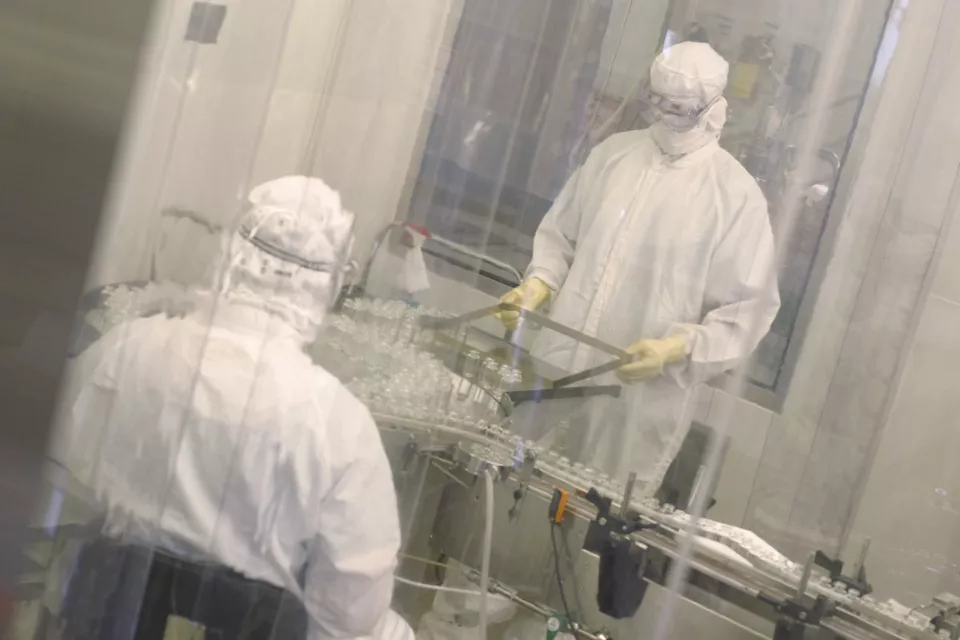
From research-scale pilot lines to large-scale facilities, automated production solutions help ensure process uniformity, data integrity, and faster transitions from development to commercial output. Real-time data insights enable immediate corrective actions and continuous improvement, empowering teams to deliver higher quality at lower cost across the product lifecycle.
Drive Quality and Speed With Real-Time Analytics

From applying automation during process development to collecting data with context during manufacturing, Emerson’s DeltaV™ technology and manufacturing systems software solutions can improve your data management, real-time product quality, reliability, and operating costs.

DeltaV™ Spectral Process Analytical Technology (PAT)
Integrate real-time analytical insights into your process automation strategy. DeltaV PAT enables inline measurement and control of critical quality attributes, reducing lab testing and accelerating decision-making on the production floor.
Solution-Related Documents for Automated Production
Explore a solution-related documents designed to support automation in life sciences production. From foundational guidance to advanced insights, these resources can help inform decision-making, improve process efficiency, and support compliance across your automation journey.


Business Groups in Automated Production
Automated production is powered by technologies that span process control, sensing, actuation, and analytics. Each business group brings specialized tools and expertise to the table—ensuring your operations are connected, responsive, and optimized from end to end. Explore how these groups contribute to more productive, more adaptive manufacturing.
Automation Systems

Measurement Instrumentation
Frequently Asked Questions (FAQs)
Explore frequently asked questions about automated production in the advanced therapy medicinal products (ATMPs) segment. Discover how automation helps improve product consistency, enable scalability, and support regulatory compliance in highly specialized manufacturing environments.
Automated production in ATMPs uses integrated control systems, robotics, and digital workflows to execute precise, repeatable processes with minimal manual intervention. It supports consistency, scalability, and compliance in producing cell and gene therapies.
Automation minimizes human error, ensures reproducibility, and enables real-time data capture. In the high-stakes ATMP environment, it helps reduce variability and improve patient safety while accelerating time to market.
Yes. Modular, scalable automation platforms can adapt as production expands—from clinical-scale batches to commercial manufacturing—without compromising compliance or product quality.
Automation ensures that critical process parameters are tightly controlled and repeatable across batches. This reduces process drift and variability, helping maintain product quality in every lot.
Automation addresses challenges like high variability, limited throughput, complex manual steps, and operator dependency. It standardizes operations and reduces the training burden on staff.
While upfront investment may be higher, automation improves efficiency, reduces rework, and accelerates scale-up, making it a cost-effective solution even for small-batch, high-value therapies.