


Unbounded Data, Boundless Power Operations
Why Data-Centric Automation Matters for Modern Power Grids
Amid an unprecedented transformation in the global power industry, utilities face three urgent mandates: transition to renewables, modernize aging infrastructure, and continue to deliver affordable, reliable power.
Emerson’s next-generation automation architecture is purposely designed to break down data silos and create a modern, future-proof industrial computing environment that optimizes operations across generation, storage and distribution. Its Ovation Automation Platform 4.0, a software-defined architecture designed to unify reliability, safety, production, and sustainability data – from the intelligent field to the edge to the enterprise. This integration enables utilities to optimize operations and adapt confidently to rapid market shifts.
A Move Toward the Edge
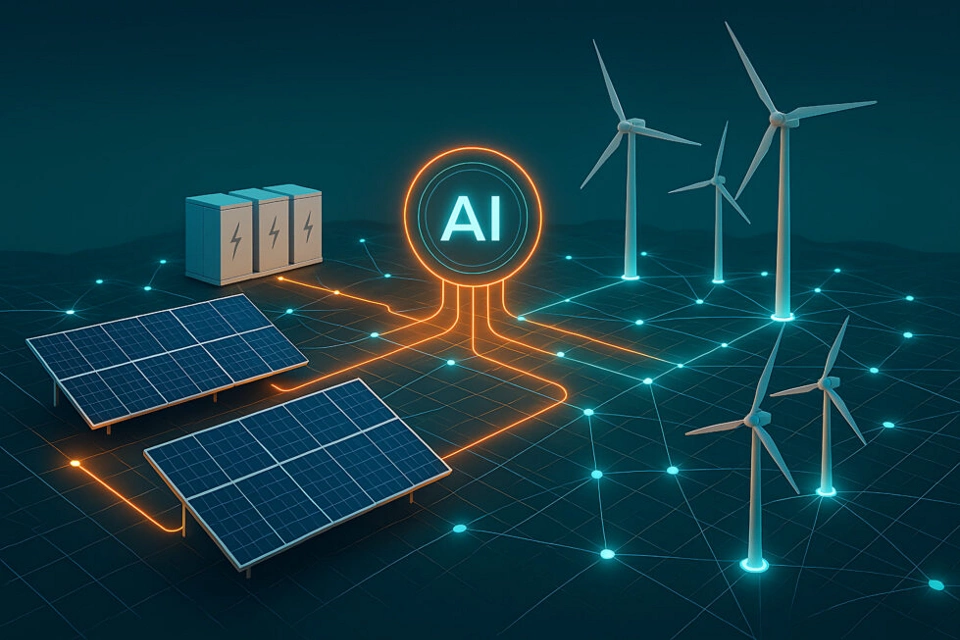
The shift toward more distributed energy resources (DERs) is driving some of the biggest changes in the power industry. These resources include combined cycle plants, wind farms, hydro facilities, solar panels, battery storage, microgrids and electric vehicle charging stations. Utilities with this complex power portfolio can rely on Ovation 4.0’s grid edge ecosystem to manage real-time, bidirectional energy flow and deliver distributed data across their entire network.
In addition, grid edge controllers provide a more granular view of the grid through high-speed, localized computing environments across DERs – securely putting rich data closer to operators to improve load and demand management.
Increased Remote Capabilities
In the face of mass retirements and worker shortages, companies are increasingly reliant on remote operation centers to centralize knowledge and take advantage of economies of scale. Centralized operations empower utilities and generating companies to do more with less, increasing operational flexibility and reducing costs. For instance, experts can analyze data to determine the long-term effects of equipment operation and degradation, for a single asset or across a fleet, to predict and mitigate failures long before they become expensive problems.
Remote monitoring is even more critical for today’s renewable energy generators and battery storage sites, which typically require very limited operator intervention and tend to be spread over wide areas. Teams can monitor these operations from a central site, then dispatch personnel as needed.
Emerson has leveraged decades of experience in power generation to develop a full suite of advanced pattern recognition and machine learning technologies for remote monitoring and control. Our new Ovation analytic software and intelligence framework leverages AspenTech’s Mtell® software and machine learning engines to auto-learn normal and abnormal operations of assets to continuously improve predictive maintenance.
Industrial AI: From Reactive to Predictive Operations
Today’s challenging power landscape requires more predictive than reactive strategies – and that’s where advanced analytics play a critical role. The modern, future-proof computing environment of the Ovation 4.0 Automation Platform will enable Emerson to deliver transformative generative AI (GenAI) that can confidently mine large, complex data sets and harness the power of advanced analytics to inform decisions, empower the workforce and optimize operations.
Emerson is excited for the emerging capabilities of GenAI and its capacity to empower the workforce of the future to make faster, safer and more effective decisions across operations. AI is poised to form the foundation for many innovations just over the horizon in industrial software, including:
- Remote operations – At centralized control centers that monitor multiple assets, AI will work in tandem with operators as autonomous guardians that provide prescriptive guidance to help with information processing and decision support.
- Reliable, continuous operations – GenAI assistants will predict maintenance requirements, helping operations teams mitigate the impacts of common reliability issues such as faulty sensors, mechanical wear, temperature fluctuations and pressure deviations. In addition, real-time digital twin simulation, coupled with AI models trained on plant-specific historic operations and maintenance, will recognize abnormal conditions to identify how and why processes are diverging from baseline operations.
- Grid optimization – Facilitated by AI-assisted predictive maintenance, control platforms will offer advanced situational awareness to improve operator decision-making from power generation to delivery, resulting in increased grid stability.
- Security – Robust AI models will be used as a tool to enhance cybersecurity by improving threat detection, response automation, vulnerability management and overall security protocols.
In today’s environment, effectively unleashing and democratizing data across all functions is critical to drive operational efficiency, enhance grid reliability and resilience, meet decarbonization goals and leverage new technologies like AI. The opportunities for better data management – and the impacts it can offer – are boundless.
As the industry steps further into a digital future, we are proud to lead the way – meeting customers where they are and creating modernization programs that do not require rip-and-replace. Wherever customers are ready, we’re here – to help simplify modernization with an open architecture pathway to more efficient control systems that put data to work.