


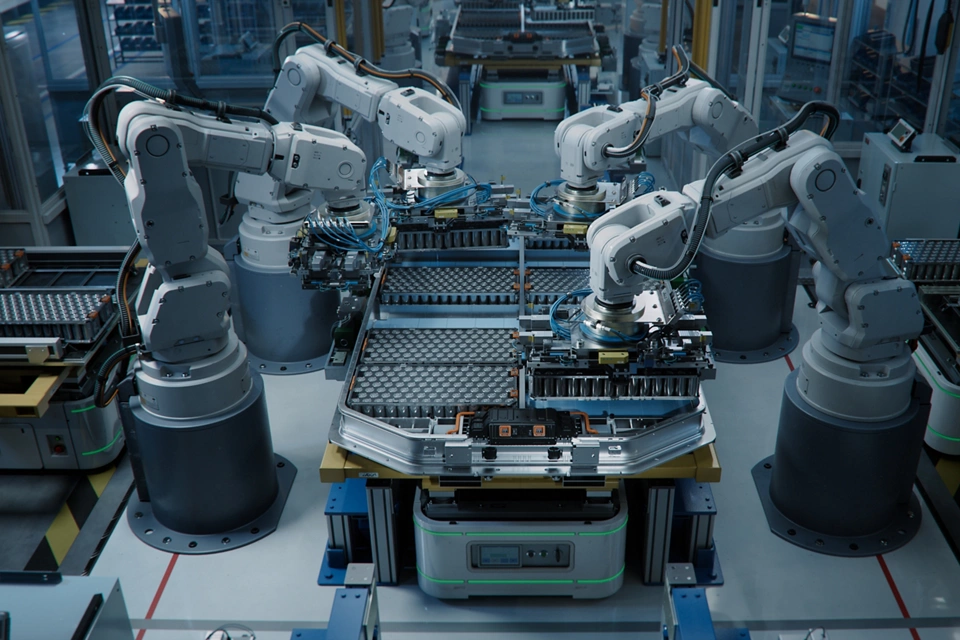
Acelerar el montaje de baterías EV de forma segura, escalable y con alta precisión mediante la automatización inteligente
Impulse un crecimiento más rápido y unas operaciones más eficientes mediante la automatización integrada y la información en tiempo real
Emerson ayuda a los fabricantes de baterías para vehículos eléctricos a crecer más rápido y operar de manera más inteligente, al ofrecerles automatización precisa, control de calidad en tiempo real e información digital que mejora la seguridad, la productividad y la sostenibilidad en el montaje de paquetes de baterías.
Soluciones de baterías de vehículos eléctricos en acción
Las soluciones de Emerson aprovechan la tecnología de automatización, el software y los servicios para ayudar a las industrias a lograr una mayor eficiencia, una seguridad mejorada y operaciones sostenibles a lo largo de toda la cadena de valor.
Datos críticos en tiempo real, confiables y seguros gracias a la integración de sistemas

La integración de datos con el sistema DeltaV ofrece información entre el campo y los sistemas empresariales con un tiempo de configuración mínimo. Los encargados de tomar decisiones en todos los niveles de la planta, desde ingeniería, operaciones y producción pueden recibir los datos críticos que necesitan de manera confiable, segura y en tiempo real.
Preguntas frecuentes (FAQ)
El proceso de montaje de las baterías para vehículos eléctricos implica pasos complejos que requieren precisión, seguridad y uniformidad. Esta sección de preguntas frecuentes ofrece respuestas claras a las dudas más comunes relacionadas con las tecnologías de montaje.
Las materias primas críticas que se utilizan en la fabricación de las baterías de iones de litio (LIB) son el litio, el grafito, el cobalto y el manganeso. A medida que aumentan las implementaciones de vehículos eléctricos, la producción de baterías de litio para VE se está convirtiendo en una fuente de demanda cada vez más importante.
La fabricación de los componentes de la batería de litio (o celda de la batería) se realiza en conjuntos de electrodos y luego se ensamblan en celdas de la batería. Para producir electricidad, las baterías de litio de VE trasbordan los iones de litio internamente de una capa, llamada ánodo, a la otra, el cátodo. Los dos están separados por otra capa, el electrolito.
Cada generación de diseño de baterías (cilíndricas, prismáticas, de bolsa de polímero y, ahora, de estado sólido) desafía los límites técnicos y es más exigente con la tecnología de montaje de baterías. Las soluciones de soldadura por ultrasonido unen de forma confiable los metales más finos y delicados y las películas híbridas avanzadas que se necesitan para fabricar baterías de mayor densidad energética.
Una batería está compuesta por un ánodo, cátodo, separador, electrolito y dos colectores de corriente (positivo y negativo). El ánodo y el cátodo almacenan el litio. El electrolito transporta iones de litio cargados positivamente del ánodo al cátodo y viceversa a través del separador. El movimiento de los iones de litio crea electrones libres en el ánodo, lo que crea una carga en el colector de corriente positivo. A continuación, la corriente eléctrica fluye desde el colector de corriente por medio de un dispositivo energizado (teléfono celular, ordenador, etc.) al colector de corriente negativo. El separador bloquea el flujo de electrones dentro de la batería.
Mientras la batería se descarga y proporciona una corriente eléctrica, el ánodo libera iones de litio al cátodo que genera un flujo de electrones de un lado al otro. Cuando se enchufa el dispositivo, ocurre lo contrario: los iones de litio son liberados por el cátodo y recibidos por el ánodo.
Uno de los mayores desafíos en lo que se refiere a los vehículos es equilibrar el peso con la potencia del combustible. Los investigadores están cambiando las características clave de la batería de iones de litio para hacer una versión completamente sólida o de "estado sólido". Reemplazan el electrolito líquido en el medio por un electrolito sólido y delgado que es estable en un amplio rango de voltajes y temperaturas.